
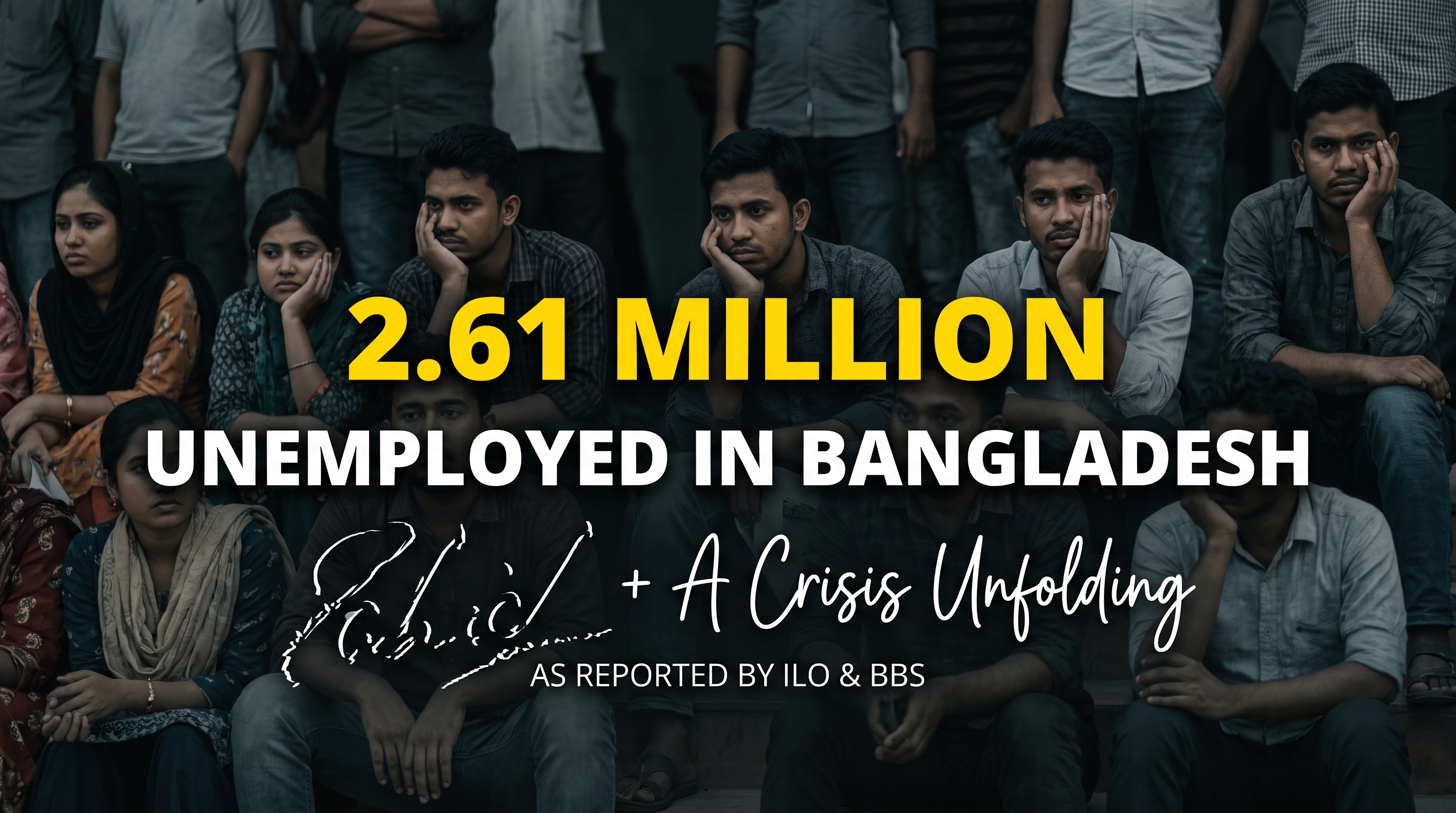
Bangladesh is a land of opportunity with a population of more than 175.4 million. According to the United Nations Development Programme (UNDP), Bangladesh is a Least Developed Country (LDC) slated to graduate this year, but market conditions and having more than 2.61 million unemployed people (ILO, 2024) could affect this process.
International Labor Organization (ILO) and the Bangladesh Bureau of Statistics (BBS) have a stringent definition of unemployment. It is defined with a few conditions:
- Working Age: The minimum working age of an individual should be above 15.
- Not in Employment: During the reference week or day, the individual is not at work for a single hour or week.
- Seeking Employment: The individual should be searching for a job or employment to be paid or set up a business during the period.
- Currently Available: The individual is available for a job or employment within a short reference period.
ILO and BBS also defined who are not in this process:
- The One Hour Criteria: People who worked or did a job for an hour are excluded, as they were employed.
- Active Job Search Requirement: Non-working individuals who want to work but are not seeking any job are also omitted.
Bangladesh actively reduced the poverty rate from 36.6% to 4.9% in 2025, and the unemployment rate in 2011 was 2.5%, whereas in 2024 it was 3.6%, which is quite significant, as reported by the ILO.
Comparing employed and unemployed population:
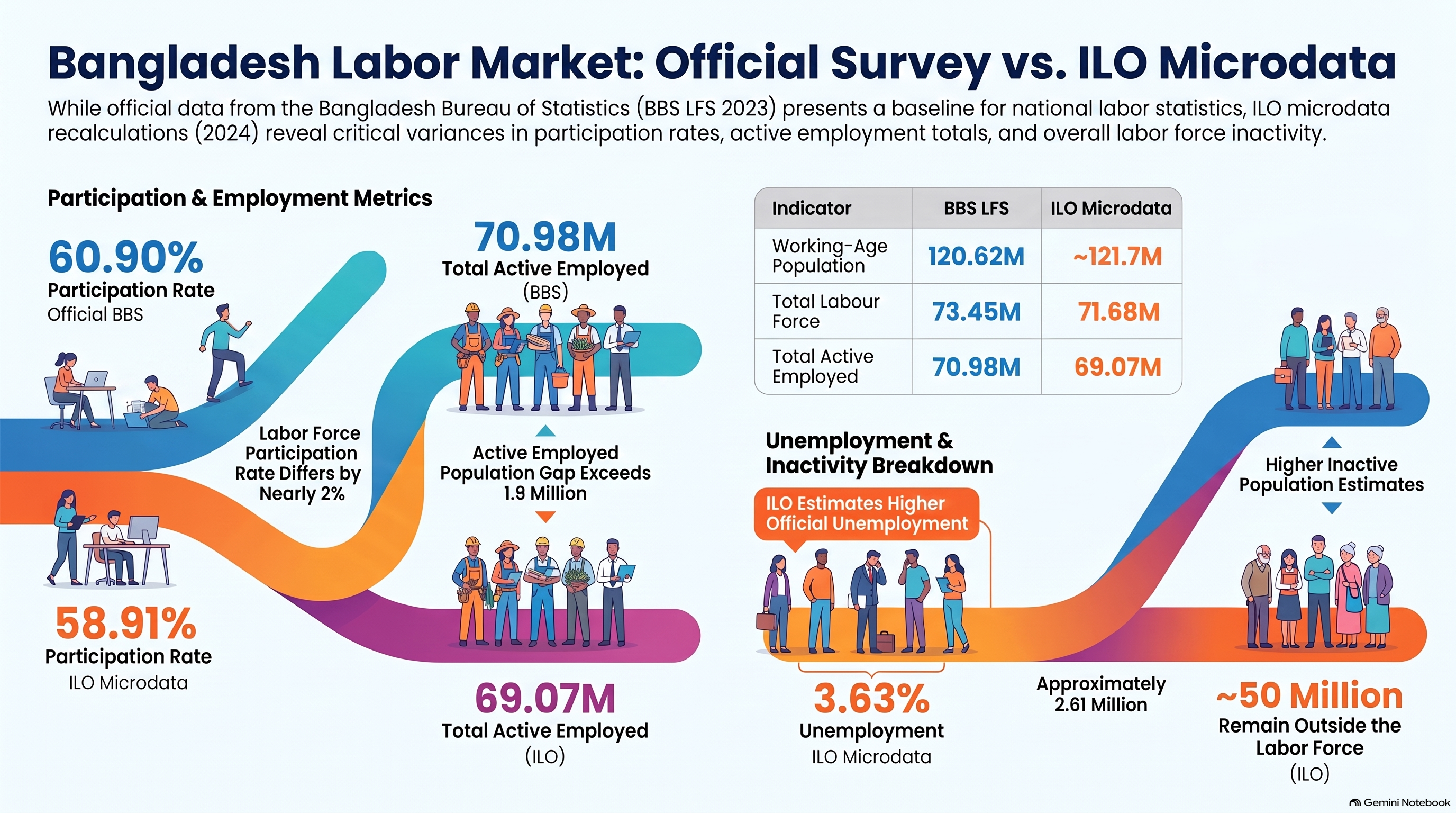
The table presents data from BBS and ILO surveys conducted in different years. In Bangladesh, the total working population is 73.45M, including 48M–48.12M males and 23.68M–25.33M females. The total employed population is 70.98M, with 46.21M–46.47M males and 22.86M–24.51M females. The unemployment rate is slightly higher among females than males, while the total unemployed population is 2.45M or 2.61M. These figures are compared using data from the ILO and BBS.
Analysis that would blow your mind:
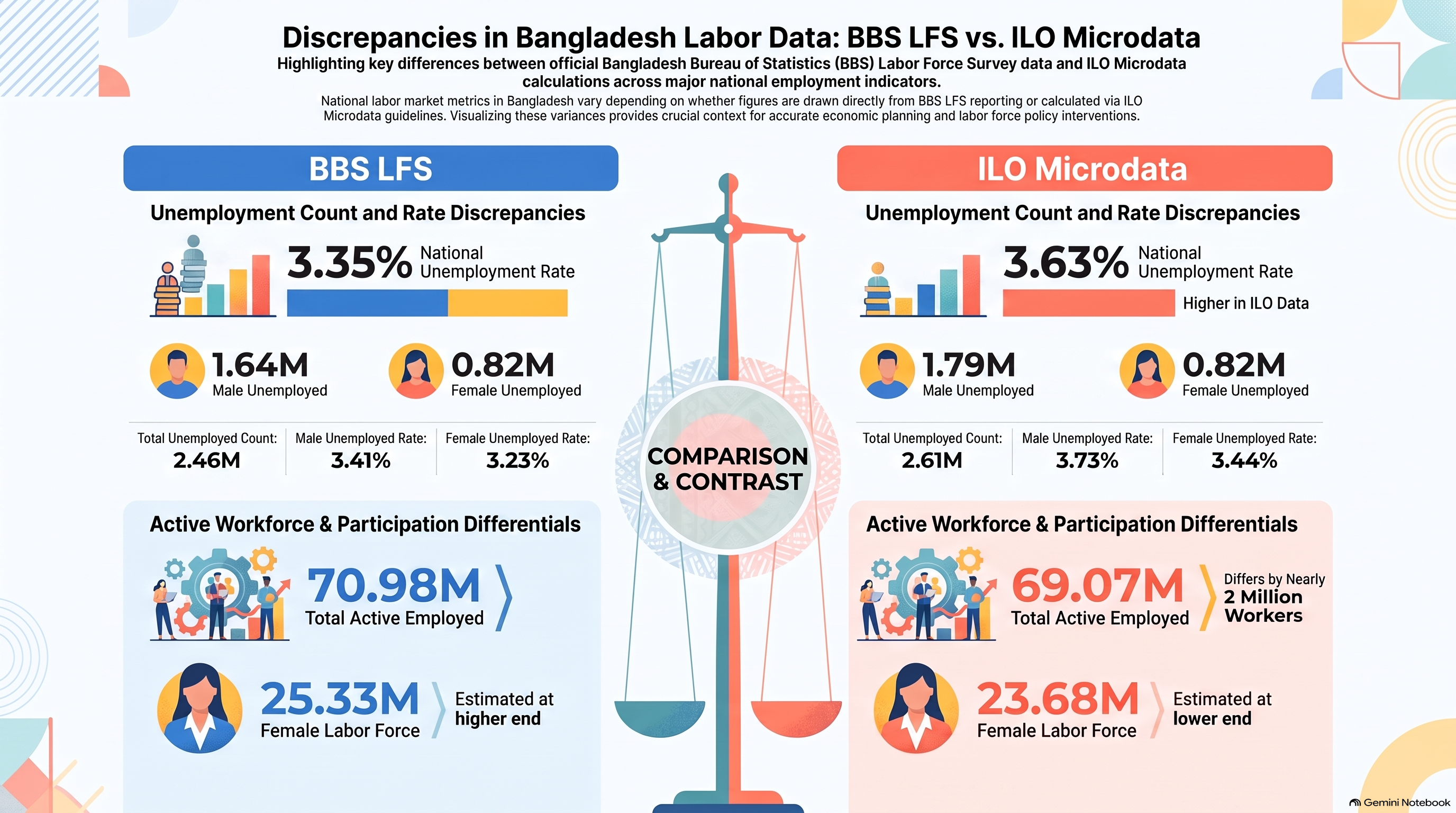
In Bangladesh, BBS reports the total number of unemployed people is 2.46M, whereas ILO reports 2.61M. Here, BBS surveyed in 2023, while ILO published the report regarding March 2026 but did the survey in 2024; that is why the numbers are different than one another. In total numbers, males account for 1.64M or 1.79M, which is 66.7%-68.6% of total unemployed persons; in the meantime, unemployed females remained stable, showing 0.82M in both datasets. Nationwide, the unemployment rate was 3.35% to 3.73% during 2023 to 2024. Male and female unemployment rates are 3.41 to 3.73, and 3.23 to 3.44%, as females remain low in absorption into informal agriculture. Both reports show total active employed people are 70.98M, but the ILO shows 69.07M, where ~1.91M workers are primarily women, as shown by the female labor force of 25.33M to 23.68M, which shrank by 1.65M between 2023 and 2024.
Urban Vs Rural Disaggregation:
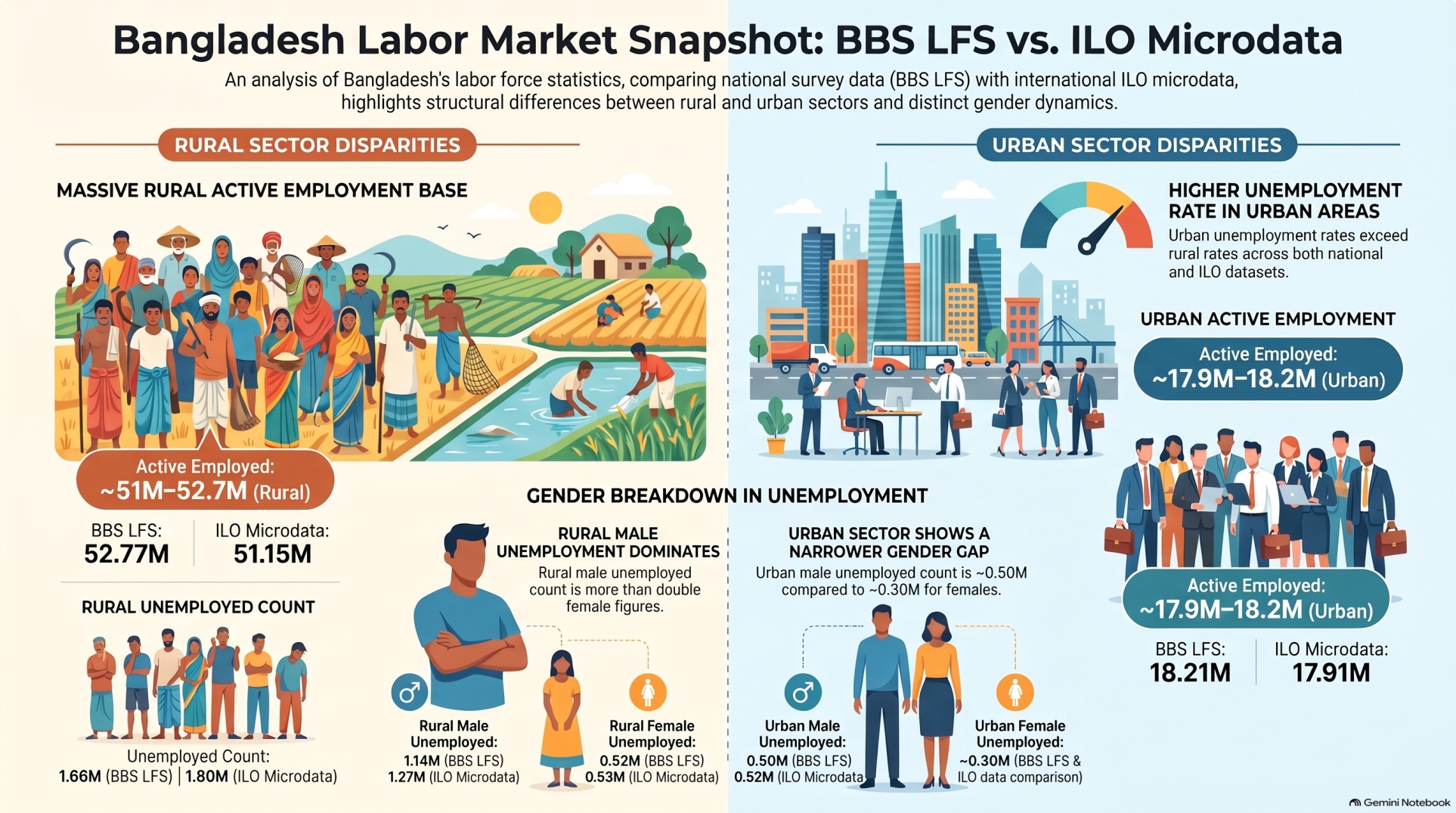
Let’s do a deep drive into urban vs. rural statistics. The unemployment count is quite high for the ILO dataset; the BBS shows 1.6M. In contrast, the ILO reported 1.80M, showing that between 2023 and 2024, more than 0.14M people were added to the unemployment count. Urban reportedly had 0.8M to 0.81M counted for these years. The rates for urban and rural areas are quite significant, as reported 3.06% to 3.25% and 4.20% to 4.35%. For rural areas, more than 1.65M women exited the labor force, which drove active employment numbers from 52.77M to 51.15M because of the post-pandemic effect, automation in garments, job displacement, discouragement, childcare, and disproportionate domestic work. On the other hand, urban active employment stayed stable at ~18M. The unemployment rate of rural men has dramatically surged from 1.14M to 1.27M; mentioned reasons include advanced education, the availability gap between educated and non-educated labor, high inflation, and socio-political unrest. However, the unemployment count for women in rural areas remained balanced at ~0.52M. Although the male and female counts also remained at the same level in urban areas at ~0.50M and ~0.30M, considering the skill mismatch, the foreign worker paradox, and the pay scale impact.
Overall workforce distribution:
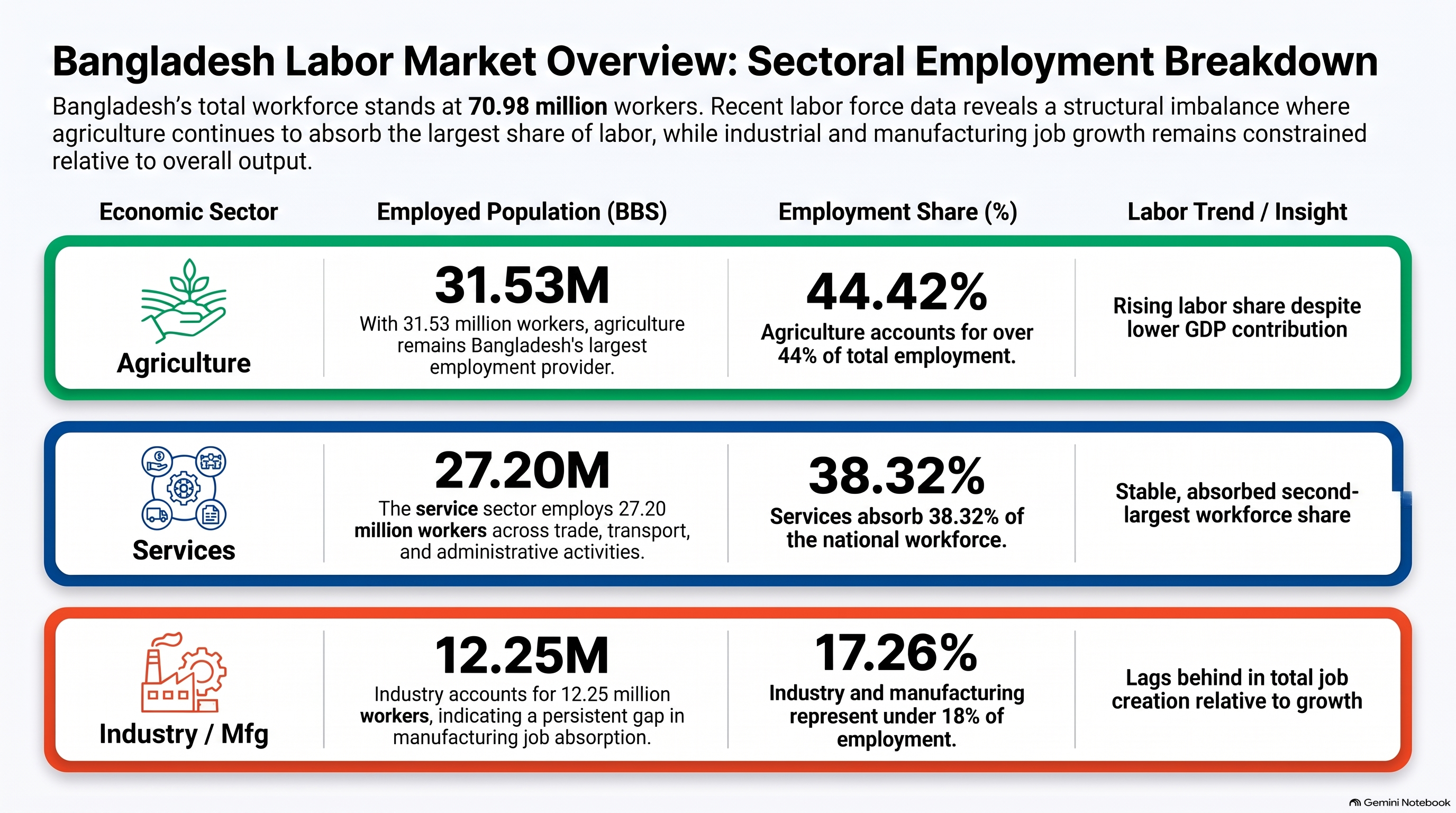
Major economic sectors include agriculture, services, and industry, which share labor forces in Bangladesh, as agriculture accounts for 31.53M, which has surged from 27.67% in 2017 to 49.9% in 2023 and 51.9% in 2024, as the ILO reported. Moreover, the share of young women workers is an extraordinary 91.7% of those employed in rural agriculture. Service sectors compose 38.32% of the total labor force, which is 27.20M, and are stable but heavily informal market services. The contraction of the manufacturing industry share is 11.76%, falling from 17.26%, considering automation, operator displacement, concentration in low-skilled roles, and private sector credit slowdown. However, 84.07% of all national jobs are informal.
Education Level Unemployment:
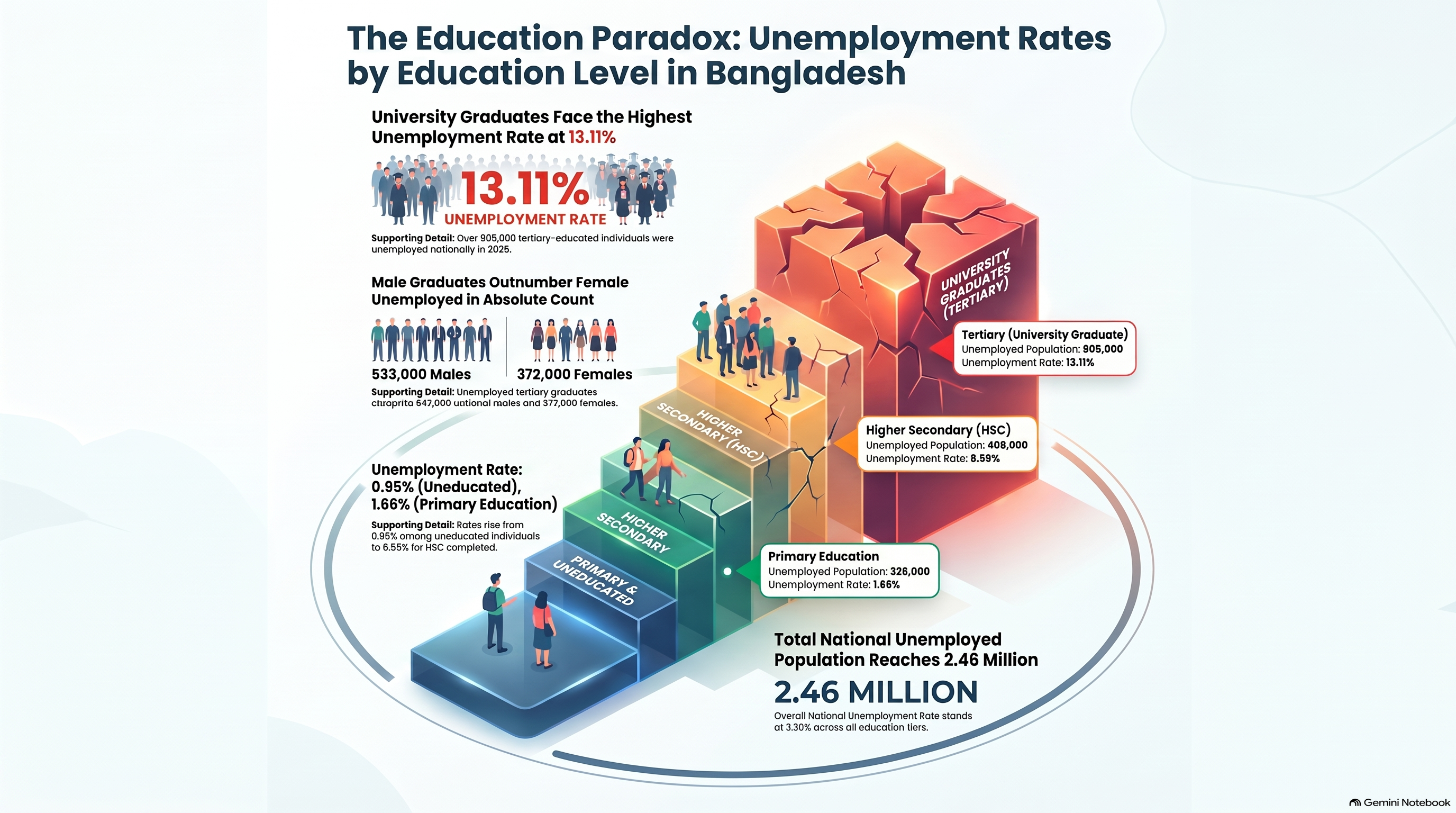
The survey included 2.461M people; university graduates face the highest unemployment rate at 13.11% (ILO: 13.50%, 2024), while the no-education group is in the safest position, with an unemployment rate of 0.95%. Male graduates outnumber unemployed females in absolute numbers: 533,00 and 372,00. Comparatively, primary and secondary level graduates have a lower rate of unemployment than higher secondary and tertiary level graduates.
Some reasons why tertiary graduates are unemployed:
- Rapid Tertiary Expansion vs. Low-skilled market: Expansion of university level graduates faster than white-collar jobs. Where tertiary graduates face unemployment rates of 13.11% to 13.50%, which is ~885,000-905,000 graduates.
- Skill and Attribute mismatch: Institutions are disconnected from modern industry demand for what they are looking for in a graduate. While jobseekers prioritize academic CGPA without earning real-world experience.
- Industry Automation: Industry automation is one of the core reasons behind making them unemployed because they might have skills that the industry does not need. Modern industry hires skilled professionals who can handle two or more jobs at a time.
- Public Sector Pay Scale Distortion: The 2026 National Pay Scale amendment raises salaries and benefits significantly, which attracts graduates to wait a long time to crack a government job. This distorts expectations, leading educated youth to be unemployed.
- Scarcity of Good Jobs & Pervasive informality: 84.07% of national employment is informal. Less than 2% of youth are working in the formal job sector, which provides social security, social protection, and health benefits.
- Salary Expectation and Market Reality: Unemployed graduates want to have salary between 20,000 BDT and 30,000 BDT for an entry-level private position. However, the economic condition of the market is poor due to unstable economic growth, lower export and import capacity, technological transformation, and other economic factors.
- Poor Work-Life Balance: Private workplaces often lack flexible hours, mentorship, and clear career paths, driving disillusioned newcomers out of formal employment.
